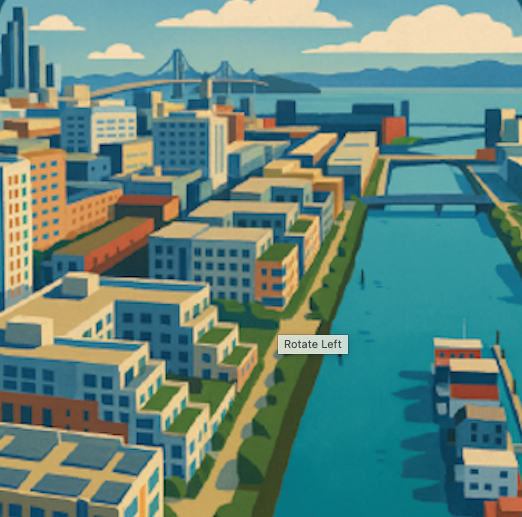
There’s economic resilience that a neighborhood needs to keep thriving even during times of social upheaval, such as a pandemic. On or near the waterfront in this age of climate change, severe winter storms, melting glaciers, and rising sea levels, there’s waterfront resilience, and protecting housing and other vital infrastructure that could be affected by sea level rise.
On July 14, the Port of San Francisco gave a detailed presentation to Mission Bay Neighborhood Association (MBNA, or Mission Bay NA), on their Waterfront Resilience Program. A second presentation by the Port focused on the soon-to-be-constructed Ferry Landing at 16th Street, across from Chase Center.
Both topics generated lively discussions between Port staff and 24 neighbors who met in the Wigeon Room of LUMA Hotel. Thanks to all who attended!
By the way, those superhigh winter tides are no longer being called King Tides. They’re now called Royal Tides.
See the attached PDFs for the Port’s presentations:
Waterfront Resilience Program (PDF)
16th Street Ferry Landing (PDF)
Economic Resilience Study Being Planned
Increasing neighborhood vibrancy — its resiliency — is a challenging thing to measure because vibrancy means different things to different people.
Jenais Zarlin, Co-Founder and Chief Impact Officer of SF New Deal, shared the following PowerPoint presentation recently on SF New Deal’s Vibrancy Index:
SF New Deal’s focus is on small businesses and supporting their success. For their prototype of the index, they focused their work on Powell Street and Maiden Lane in Union Square where “Vacant to Vibrant” was happening.
They focused on four metric categories: Public Space, Public Life, Identity, and Economic Vitality. To collect the data, they surveyed people on the street and online, as well as place and people observation, and talked with local businesses.
This project will be expanding to five neighborhoods in the coming year including Mission Bay — if a volunteer team to support it can be formed.
SF New Deal will be looking to local residents to help determine the survey questions and metric weightings, and to define a zone of study – ideally a stretch of two blocks that are a mix of busy and struggling businesses. The plan for neighborhood engagement of surveying and data collection, once the zone of study is defined, spans over eight weeks. Since it’s a big undertaking, the start date is likely to be Spring 2027.
To be clear, at the conclusion of this project, SF New Deal will present data findings only. It will be up to Mission Bay entities to drive the decisions for developing some type of proactive strategy in response to the findings.
Mission Bay Neighborhood Association has been invited by the more expansive and older established South Beach Rincon Mission Bay Neighborhood Association (SBRMBNA) to join them and other Mission Bay entities in planning the study. It’ll be an item for discussion among Mission Bay NA’s Board of Directors in the months ahead, and the thoughts and input from neighborhood residents and business owners are encouraged. Feel free to send questions or comments on MBNA’s participation to info@missionbayna.org.
Leave a Reply