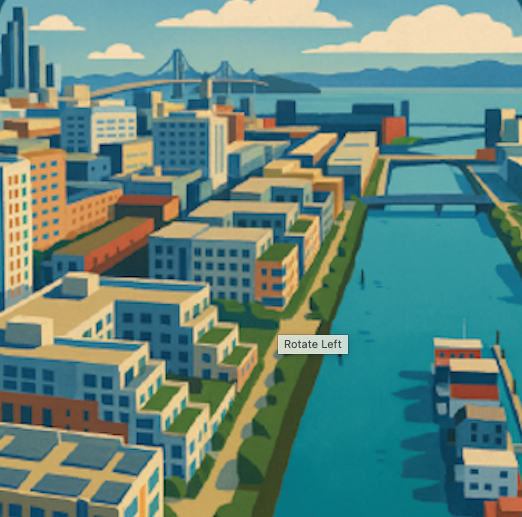
University of California, San Francisco (UCSF) will begin pre-construction activities for their new Bakar Ear and Hearing Institute on half of Block 16 later this year. The parcel sits between Mission Bay Blvd. South and Nelson Rising Lane, across from SPARK Social on Mission Bay Commons.
The building will house out-patient clinic care, physical therapy (to treat dizziness, vertigo, and balance problems caused by inner ear disorders), a Magnetic Resonance Imaging (MRI) suite, two floors of research laboratories and educational spaces that will include a symposium area. The structure will hold 154,000 square feet of space for these uses and rise five stories to a maximum height of 105 feet, 25 feet taller than the Mission Bay School at four stories, a couple of blocks west.
The Institute will aim to advance treatment and research for hearing loss, including the development of cochlear implants and gene therapies.
Community members who attended a meeting in UCSF’s Wayne and Gladys Valley Center for Vision at 490 Illinois Street last Wednesday were shown a rendering of a sleek, modern design with corner cutouts staggered in location on the structure from floor to floor. The design was chosen to relieve a long elevation appearance that would otherwise be created by the building’s vertical height.
The project team of Mike Jackson and Jerry O’Hearn heard concerns related to wind shear effects the structure might have in a naturally windy area; whether the corner cutouts would relieve the effects of shadows on surrounding sidewalks; why the main drop off location for patients is planned for MB Blvd. South when that’s a busy through-street for vehicles traversing Mission Bay from west to east; and how dust stirred up by pre-construction activities will be contained by the construction crew. The answer to that last one is, by dousing the dirt with water.
The other half of the parcel will be landscaped with outdoor seating in a garden-like setting. One audience member requested that the seating be comfortable.
Drill, not Drive
Securing a foundation in Mission Bay’s loose fill will require compacting the soil at the site, and conducting exploratory testing for depth below ground where piles can be attached to sturdy mooring. The piles will extend to the bedrock, and the project team told us that to spare neighbors the noise, echoes, and vibrations of pile-driving, they will use another method to install the piles – drilling.
The presenters, who’ve had experience in Mission Bay developing the Uber buildings, also discussed construction vehicle routes to and from the site, and noted they will have schedules for home games and other events at Chase Center and Oracle Park taped up where they can see them, to be able to schedule movement of trucks so they don’t add to congestion.
Simultaneous Construction Projects?!?
Audience members asked numerous questions about how this construction project would interact with the pending development of a permanent public park across the street, currently occupied by SPARK Social’s eclectic collection of food trucks, fire pits, and picnic tables. Indeed, one of the assembled community members was Ashlyn Badea, who works in operations for the popular gathering place. SPARK Social is also keenly awaiting more details. Final designs for converting the interim use by SPARK Social into a more aesthetically pleasing outdoor dining area with nicer fencing and new seating are expected this summer from Mission Bay Development Group (MBDG).
The UCSF project team is eager to meet with MBDG and coordinate, as the two developments appear to be on track for simultaneous construction. At this point, how it’ll work to have two active construction sites across the street from one another is a matter of faith.
Questions not asked in Wednesday’s meeting – but ought to be brought up – would focus on traffic circulation beyond Mission Bay Blvd. South. If simultaneous construction activities slow traffic on this route, how might rerouted traffic affect that other main west to east through-street, Channel Street, which already gets backed up eastbound on a regular basis?
Will it affect circulation at the traffic circle – itself slated for a safety overhaul, if we ever get those redesign plans from San Francisco County Transportation Authority (SFCTA)?
It’ll be a period of disruption for neighbors, to be sure. Vehicle routes will be affected by the construction activity just as a new elementary school is expected to bring more vehicles into the area, and it is not yet known how that increased traffic flow will affect local streets. It will all need to be closely monitored, with active engagement by community members willing to work together, and work with contacts at UCSF, MBDG, and SFCTA.
Indeed, much of the point of the meeting was to ensure communications channels between neighbors and UCSF’s Community and Government Relations team, who organized the strongly attended meeting.
Missed It this Time? There Will Be Other Chances
UCSF’s project team is eager to present to community groups. They’d anticipated presenting at the April Mission Bay Citizens’ Advisory Committee (MB CAC) meeting, but instead of being rescheduled for the following week to allow for a neighborhood Town Hall on street safety, the CAC meeting was canceled. The UCSF team does plan to talk to the CAC in May.
Told that a new Mission Bay Neighborhood Association is forming and would want to see renderings of the Hearing Institute, UCSF Community and Government Relations staff and the project team said they are seeking exactly such opportunities to show their plans and address neighbors’ concerns.
Mission Bay Community Showing Strong Engagement
UCSF’s meeting included a contingent of community members who know each another from MB CAC meetings. Fernando Enciso-Marquez, who represents UCSF’s Community and Government Relations team on the MB CAC, drew on a deep reserve of neighborhood contacts to bring together a full house.
“I see a lot of community advocates in this room,” he said to kick off the meeting, and rattled off the names of a few.
Fernando and Ellie Rossiter, his colleague on UCSF’s Community and Government Relations team, had attended the Mission Bay Street Safety Town Hall organized by Supervisor Matt Dorsey on April 9. That meeting had a large presence of parents with young children mixed in with neighbors of all ages and abilities, a response to the death of a toddler in the neighborhood’s most visible intersection.
Ellie remarked that it’s impressive to see how engaged the Mission Bay community is, and how neighbors show up for conversations that will determine the future of our rapidly growing neighborhood.
And that, in a nutshell, is the reason a new civic group is forming. To be a vehicle for further community engagement on topics that will decide Mission Bay’s future. To provide a forum for dialogue that really hears differing points of view.
To continue this powerful momentum and raised awareness of Mission Bay being a Community of Interest, see the announcement for details of the May 7 meeting at LUMA Hotel. We’d love for you to join us, and to hear your thoughts. Click here to RSVP. (Sold out? No worries. Come anyway.)